
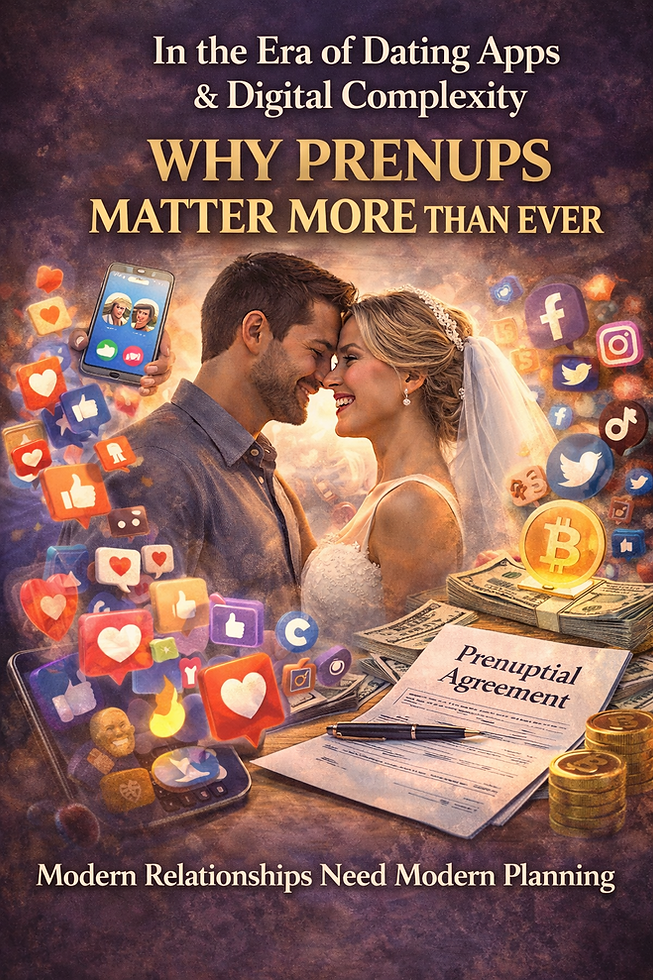
How the Digital Era and Dating Apps Changed Relationships and Why Prenuptial Agreements Matter More Than Ever
- Ana Fotiny
- Jan 18
- 3 min read

The way people meet, date, and form long-term relationships has fundamentally changed. Dating apps, social media, and constant digital connectivity have reshaped expectations around commitment, intimacy, and partnership. While technology has made it easier to meet people, it has also introduced new complexities into modern relationships especially when those relationships lead to marriage.
As relationships evolve, so must the legal frameworks that support them. In today’s digital era, prenuptial agreements are no longer relics of the wealthy or the pessimistic. They have become practical tools for couples navigating marriage in a world shaped by online dating, financial independence, and rapidly changing social norms.
The Digital Dating Revolution
Dating apps have transformed relationships from proximity-based encounters to algorithm-driven matches. People now meet partners outside their social circles, professions, cultures, and even countries. While this has expanded opportunity, it has also altered how relationships begin and develop.
Many couples spend less time getting to know each other before committing. At the same time, people marry later in life, often after years of dating, cohabitation, or multiple prior relationships. By the time marriage occurs, both partners may bring significant assets, debt, businesses, or online-based income streams into the union.
Marriage today rarely begins at “zero.”
Commitment in an Era of Choice
The digital era has normalized constant choice. Dating apps create the perception that alternatives are always available, which has changed how people think about exclusivity and permanence. Concepts like “situationships,” long-term cohabitation without marriage, and delayed commitment are now common.
When couples do decide to marry, they often do so with a heightened awareness that relationships are not guaranteed to last forever. This awareness is not cynicism—it is realism shaped by experience and cultural shifts.
A prenuptial agreement reflects this reality. It allows couples to acknowledge uncertainty while still choosing commitment.
Financial Complexity Has Increased
Digital platforms have also transformed how people earn money. Many individuals now have:
Freelance or gig-based income
Online businesses
Influencer or content-creation revenue
Cryptocurrency or digital assets
Remote work tied to multiple jurisdictions
These income streams often fluctuate and may not fit neatly into traditional marital property frameworks. Without a prenup, disputes over ownership, valuation, and division can become complicated and expensive.
A well-drafted prenuptial agreement can:
Define ownership of digital assets
Clarify treatment of online income
Protect intellectual property
Address future business growth
This is particularly important for entrepreneurs and professionals whose earning potential may increase during marriage.
Transparency Builds Stronger Marriages
Contrary to popular belief, discussing a prenuptial agreement does not weaken a relationship. In many cases, it strengthens it.
Prenup discussions require couples to talk openly about:
Income and debt
Spending habits
Financial goals
Career expectations
Risk tolerance
These conversations often reveal issues that would otherwise surface later—during times of stress or conflict. Addressing them early creates clarity and mutual understanding.
In a digital age where communication is constant but often superficial, a prenup encourages deeper, more intentional dialogue.
Social Media, Privacy, and Legal Risk
Modern marriages also exist online. Social media can amplify conflict, expose private information, and complicate separations. A prenup can include provisions related to:
Privacy
Confidentiality
Use of shared digital accounts
Control of online content and branding
These issues did not exist in prior generations, but they now carry real legal and financial consequences.
Marriage as Both Emotional and Legal
Love remains central to marriage, but marriage itself is a legal institution with enforceable rights and obligations. The digital era has not changed that reality it has made it more complex.
A prenuptial agreement does not diminish romance. Instead, it aligns marriage with modern life by providing structure, predictability, and protection for both partners.
Choosing a prenup is not about planning for failure. It is about planning responsibly in a world that has changed.
Conclusion: Modern Love Requires Modern Planning
Dating apps and digital culture have reshaped relationships in profound ways. Couples marry later, bring more complexity into marriage, and face legal challenges that did not exist a generation ago.
Prenuptial agreements are no longer exceptional they are adaptive tools for modern relationships. In a digital era defined by choice, mobility, and financial complexity, planning is not pessimism. It is wisdom.
Marriage is still a leap of faith. A prenup simply ensures that both partners land on solid ground.



Comments